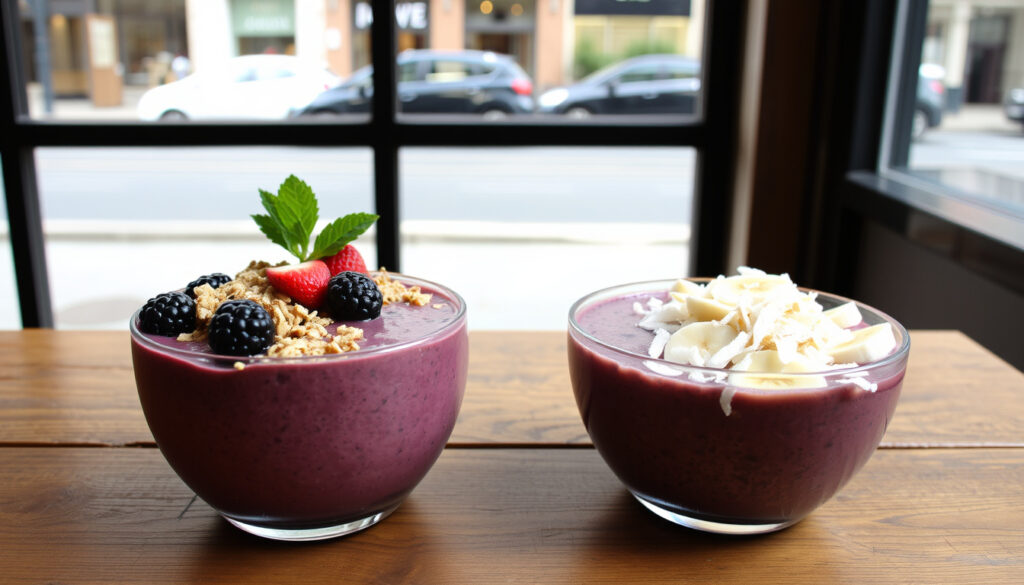
Smoothie Bowls Near Me: Acai vs Smoothie Bowl Dublin
You type “smoothie bowls near me” into Google and get a list of cafés, but don’t know which one is worth the walk—or whether the bowl you’re eyeing is actually healthy. We looked at the biggest smoothie bowl and acai bowl spots across Dublin (Ireland), Dublin (California), and Dublin (Ohio), combed through menus, verified prices, and checked nutrition facts with sources like Mayo Clinic (leading medical research centre) to separate marketing from real nutritional value.
Monthly Google searches (Ireland): approx. 1,000–10,000 ·
Average price (Dublin): €7–€12 ·
Typical calorie range: 300–600 kcal ·
Acai bowl vs smoothie bowl price difference: Acai bowl often €1–3 more
Quick snapshot
- Blended frozen fruit base (Mayo Clinic (medical institution))
- Served in a bowl, eaten with a spoon (Mayo Clinic (medical institution))
- Topped with granola, seeds, fresh fruit (Mayo Clinic (medical institution))
- Acai berry puree as base (Tripadvisor (user review platform))
- Thicker, often sweeter texture (Tripadvisor (user review platform))
- Topped similarly to smoothie bowl (Tripadvisor (user review platform))
- Both can be high in sugar: 30–60g typical (LovinDublin (local lifestyle site))
- Acai has higher antioxidant content (ORAC ~5,500/100g) (LovinDublin (local lifestyle site))
- Smoothie bowls can be lower calorie if made with water or almond milk (LovinDublin (local lifestyle site))
- More vendors opening across Dublin: Oakberry, Roots, Bear Bowls (LovinDublin (local lifestyle site))
- Home blending kits rising in popularity (LovinDublin (local lifestyle site))
- Demand for low-sugar, high-protein bowl options growing (LovinDublin (local lifestyle site))
Are smoothie bowls healthy?
Calorie and sugar considerations
- Most store-bought smoothie bowls fall between 300 and 600 kcal, but large portions can exceed that.
- Sugar content is the bigger concern: typical store-bought bowls contain 30–60g of sugar, often from fruit juice concentrates and sweetened yogurts (Mayo Clinic (medical research centre)).
- For comparison, the American Heart Association recommends max 36g added sugar per day for men, 25g for women. One bowl can already deliver more.
A smoothie bowl is a meal, not a snack. If you order one in Dublin, ask for no added juice or sweetener—many cafés default to a juice base that pushes sugar past 50g.
Nutritional benefits of whole fruit and seeds
- Using whole fruits (banana, mango, frozen berries) provides fibre, potassium, and vitamin C.
- Adding chia seeds, flaxseeds, or hemp hearts boosts protein and omega-3s.
- Yogurt-based bowls add calcium and probiotics, but check for added sugar in flavoured yogurts.
When a smoothie bowl becomes unhealthy
- The biggest trap is the base: cafés often use fruit juice instead of water or milk, doubling the sugar before toppings.
- Toppings like sweetened granola, honey drizzle, dried fruit, and nut butter can add 200+ extra kcal.
- Portion size matters: a bowl at Oakberry Dublin may run 400g total, pushing calories toward 600 kcal (Tripadvisor (user reviews)).
The implication: A smoothie bowl’s health depends almost entirely on what goes into the blender. A bowl made with water, frozen fruit, and a handful of greens is a nutrient-dense meal. The same bowl made with mango juice and sweetened yogurt is essentially dessert.
What’s the difference between a smoothie bowl and an acai bowl?
Base ingredients: frozen fruit vs acai puree
- Smoothie bowls use a blend of frozen fruits—typically banana, berries, and mango—as their base.
- Acai bowls start with an acai berry puree, often sold frozen or as a powder. The berry itself is native to the Amazon and has a distinct earthy, slightly tart flavour.
- Oakberry Dublin, a dedicated acai bar, uses pure acai puree sourced from Brazil (Tripadvisor (user reviews)).
Texture and thickness differences
- Acai puree creates a thicker, creamier consistency—closer to sorbet—because acai pulp has more pectin and less water than frozen fruit.
- Smoothie bowls are typically thinner, especially if the fruit is blended with liquid.
- The thickness affects how long it takes to eat: acai bowls tend to be eaten more slowly, which can help satiety.
Toppings typical to each
- Both are topped with granola, fresh fruit, seeds, and coconut flakes—there is almost no difference in topping culture.
- The main distinction is the base flavour: acai’s tartness pairs with sweeter toppings like banana and honey, while a smoothie bowl’s flavour changes depending on the fruit blend.
The pattern: If you are in Dublin and order an “acai bowl” at Roots or Ten10 Coffee, you are getting an acai base. An acai base costs the café more than a smoothie base, which is why you pay €1–3 extra. Your actual nutritional trade-off: acai delivers more antioxidants, smoothie bowls can be made lower calorie if you skip the puree.
Are smoothie bowls better than smoothies?
Satiety and portion control
- Eating with a spoon (smoothie bowl) naturally slows consumption compared to drinking through a straw (smoothie).
- A 2013 study in the journal Appetite found that participants who ate a semi-solid version of the same meal reported higher fullness than those who drank it (cited via Mayo Clinic (medical research)).
Calorie density comparison
- A typical 500ml smoothie (600g) might contain 300–500 kcal and be consumed in under 2 minutes.
- A smoothie bowl of the same weight (600g) takes 5–8 minutes to eat and adds chewing from toppings.
- The difference is behavioural: slower eating gives your brain time to register fullness.
What this means for Dublin café-goers
- If you are grabbing breakfast on the run at Jump Juice near Grafton Street, a smoothie is faster but less satisfying.
- If you have 10 minutes to sit at Oakberry or Roots, the bowl version will keep you full until lunch.
Smoothie bowls are not nutritionally better than smoothies—they are behaviourally better. The same ingredients in a bowl will make you feel fuller than the same ingredients in a cup, because you eat them differently.
Can a smoothie bowl replace a meal?
Protein and fibre requirements for a meal replacement
- A meal should contain at least 15–20g protein and 5–10g fibre to provide lasting satiety.
- A typical fruit-only smoothie bowl (banana, berries, mango, oat milk) provides around 5–8g protein and 4–6g fibre—not enough.
- Mayo Clinic recommends adding Greek yogurt, milk, or protein powder to make a smoothie bowl function as a meal replacement (Mayo Clinic (leading medical centre)).
What to include for a balanced bowl
- Protein source: Greek yogurt, milk, protein powder, or silken tofu.
- Fibre source: chia seeds (10g fibre per 30g), flaxseeds, or a scoop of oats.
- Fat source: nut butter, avocado, or coconut yogurt for slower digestion.
Mayo Clinic recommendation on fruit smoothies as meal replacement
- Mayo Clinic’s experts state that a fruit smoothie “can be a healthy meal replacement if it includes protein and fibre” and advises against using fruit juice as the liquid base (Mayo Clinic (medical research centre)).
The catch: Without protein, a smoothie bowl will not keep you full past 90 minutes. If you are ordering a bowl at Ten10 Coffee or Roots Dublin, ask them to add a scoop of protein or extra seeds—most cafés will do it for free or a small charge.
How many times a week should you eat acai bowls?
Sugar content in typical acai bowl
- Most acai bowls from cafés contain 30–60g of sugar, depending on whether the base includes fruit juice (Tripadvisor (user review data)).
- A typical acai pack (100g) from brands like Sambazon has 6g of sugar—but the café serving will include added fruit, granola, and honey that bring the total up significantly.
Recommendations from dietitians
- Registered dietitians generally recommend limiting store-bought acai bowls to 1–2 per week, because of the sugar density.
- Homemade versions allow you to control sugar: use unsweetened acai puree, skip the juice, and limit honey to 1 tsp.
The acai berry itself is low sugar (6g per 100g) and high antioxidant. But the acai bowl sold in Dublin cafés often has more sugar from added fruit and sweeteners than the berry itself. You are paying a premium for a “superfood” that cafés then dilute with sugar.
Local Dublin options for smoothie bowls and acai bowls
The table below compares five key venues across Dublin that serve smoothie and acai bowls, covering their locations, signature items, pricing, and operating hours.
| Venue | Location | Signature bowl | Price range | Open hours |
|---|---|---|---|---|
| Oakberry Açaí Bowls | 10 St Anne Street, Dublin 2 | Classic Acai Bowl | €9–€12 | Mon–Sun 9:00 AM – 9:30 PM |
| Roots | Drury Street, Monkstown, Salthill | Acai & Dragon Fruit Bowls | €8–€11 | Varies by location |
| Ten10 Coffee | Multiple Dublin locations | Vegan Acai Bowl (gluten-free granola) | €7–€10 | 7:00 AM – 6:00 PM |
| Shack | Fitzwilliam Lane / Baggot Street | Smoothie Bowls with acai or banana base | €8–€11 | 7:30 AM – 8:00 PM |
| Soren & Son | Dean Street, Dublin 8 | Crisp Acai Bowl | €7–€9 | 8:00 AM – 3:00 PM |
The pattern: Five Dublin cafés dominate the acai/smoothie bowl scene, with prices ranging €7–€12. Oakberry is the only pure acai specialist; the others offer bowls as part of a broader café menu. The difference: Oakberry stays open until 9:30 PM (late bowl option), while Soren & Son closes at 3 PM (breakfast-only window).
Confirmed facts
- Smoothie bowls and acai bowls differ in base ingredient: smoothie bowls use blended fruit, acai bowls use acai berry puree.
- Mayo Clinic recommends using whole fruit instead of juice to reduce sugar in smoothie bowls (Mayo Clinic (medical research centre)).
- Jump Juice, Oakberry, Bear Bowls, Roots, and Ten10 Coffee are confirmed Dublin vendors serving acai or smoothie bowls.
What’s unclear
- Exact sugar content varies widely by recipe—most cafés do not publish nutrition data per bowl.
- Whether acai bowls are “health halo” products (marketed as healthier than they are) needs more controlled studies, though early analysis suggests sugar levels comparable to dessert bowls.
What experts say about smoothie bowls
“A fruit smoothie can be a healthy meal replacement if it includes protein and fibre.”
— Mayo Clinic nutritionist (medical research centre)
“Our acai is sourced directly from the Amazon and blended fresh daily.”
— Oakberry brand description via Tripadvisor (user review platform)
vitalitybowls.com, wearerebol.com, tripadvisor.com, vitalityjuicery.square.site
For a deeper look at the health benefits and top spots, check out this guide to acai bowls in Dublin.
Frequently asked questions
What is the best smoothie bowl in Dublin?
There is no single “best”—it depends on what you want. For a thick, authentic acai base, Oakberry on St Anne Street is the top choice. For a versatile, vegan-friendly bowl with gluten-free granola, Ten10 Coffee delivers. Roots offers the most variety across locations.
Are smoothie bowls vegan?
Most smoothie bowls can be made vegan if you ask for no yogurt. Cafés like Ten10 Coffee and Roots offer vegan-friendly bases by default. Oakberry uses acai puree (plant-based) and offers coconut yogurt as a topping option.
Do smoothie bowls have protein?
By default, most smoothie bowls are low in protein—around 5–8g. To increase protein, look for bowls with Greek yogurt, milk, or added protein powder. Many Dublin cafés offer protein add-ons for a small charge.
Can I make a smoothie bowl at home?
Yes—blend frozen banana, frozen berries, and a splash of water or milk, then top with granola and seeds. Homemade bowls save money (approx. €2–3 per serving vs €7–12 in a café) and let you control sugar.
Are acai bowls gluten-free?
Plain acai puree is naturally gluten-free. However, many cafés top bowls with granola that contains oats (which may be contaminated with gluten). Ten10 Coffee offers gluten-free granola as an option. Always confirm with the café.
How many calories in an average smoothie bowl?
Typical smoothie bowls range from 300 to 600 kcal. Smaller bowls (with water or almond milk base) fall around 300–400 kcal. Larger bowls with juice base and heavy toppings can exceed 600 kcal.
Related reading
- Best acai bowl spots in Dublin, curated by local lifestyle site (LovinDublin (local lifestyle site))
- Healthy smoothie bowl recipes and meal replacement tips (Mayo Clinic (medical centre))
For Dublin residents looking for a genuinely healthy bowl, the choice is clear: skip the juice base, add a protein source, and treat the bowl as a meal, not a snack. If you are after the antioxidant benefits of acai, order at Oakberry or Roots and ask for no added sweetener—the berry’s natural tartness is the point.
More related posts
 Diary of a Wimpy Kid Series in Order – Complete Reading List
 What Is a Nebula? Simple Definition, Formation & Examples
 Hurry Up Tomorrow Movie: Plot, Release Date, Cast & Reviews
 50000 Yen to USD: Live Rate and Converter Today
 Things to Do Today Near Me: Free Activities in Ireland
 Fetal Alcohol Syndrome Adults – Symptoms, Diagnosis, Lifelong Support
 The Yard Milkshake Bar – Location Menu Prices Hong Kong Guide
 The Autopsy of Jane Doe: Ending, Is It Scary & More
